
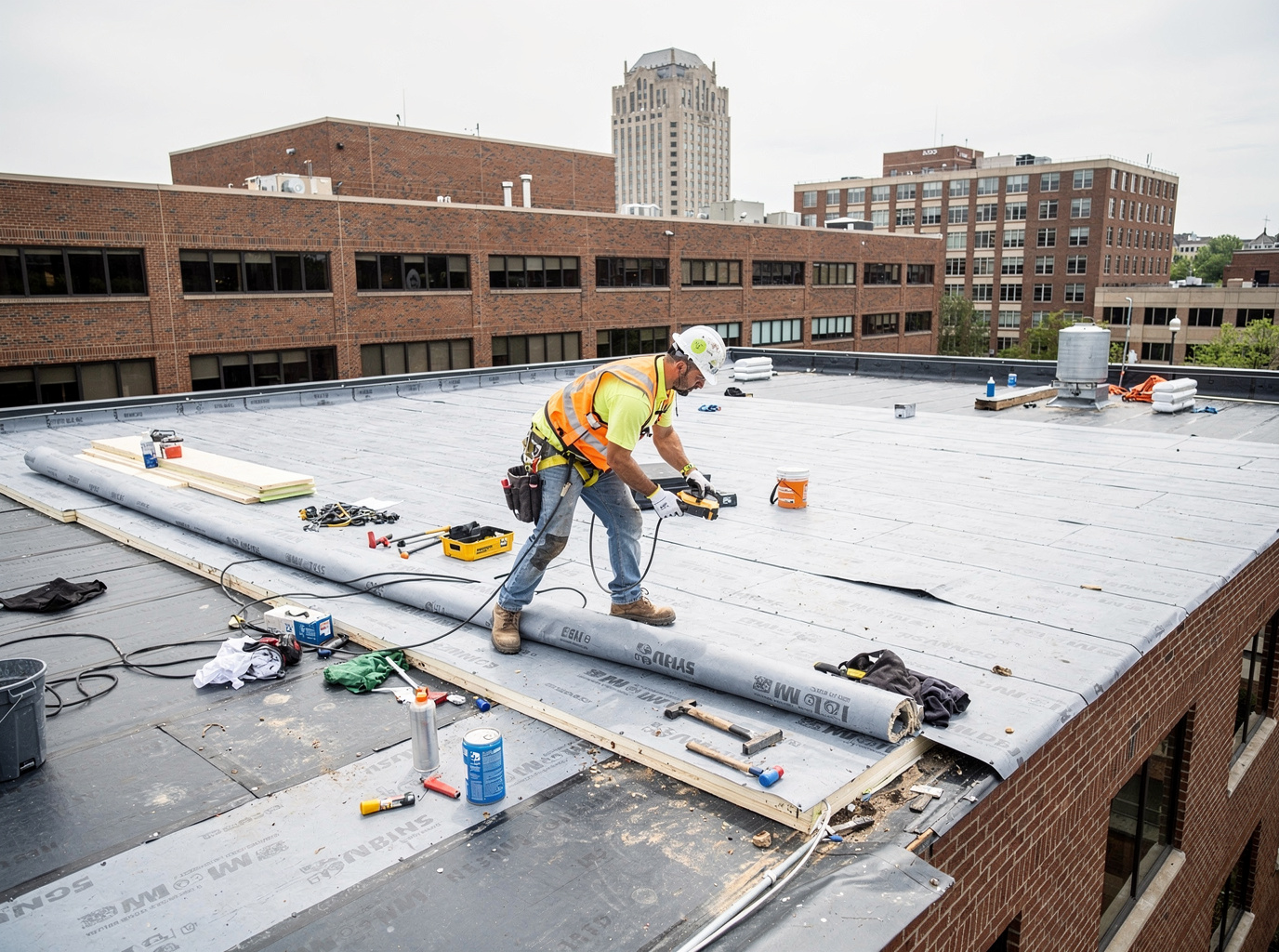
Commercial roof replacement works best when you define the roof, the membrane and the tenant plan before bids go out. Property managers and owners of small office, retail and light-industrial buildings can use the planning flow below to write a scope that tenants and bidders can both follow. Call (410) 438-1686 to arrange a roof inspection.
A planning flow
- Confirm ownership, lease terms and who approves work with tenants.
- Document the existing roof: layers, drains, penetrations and equipment.
- Choose the membrane and read the manufacturer's published installation and warranty requirements.
- Agree access, staging, work hours and noise limits with tenants.
- Set a written allowance for deck repair and for wet insulation found at tear-off.
- Plan close-out: cleanup, walkthrough and manufacturer paperwork.
Drainage facts to bring to bidders
Ponding on a commercial roof is a tenant and maintenance risk as well as a drainage one. See flat roof replacement for membranes and drainage, then ask each bidder where the water will go and which manufacturer specification applies.
Scheduling around tenants
Phased work on one section at a time can keep entrances open. Agree early-morning or off-hours work, protect air intakes during tear-off, and decide who communicates changes. Multi-tenant buildings in Hunt Valley and similar business areas benefit from a written access plan every tenant has seen.
Scope items bidders often leave out
Typical omissions include equipment disconnection and reconnection, wet insulation removal, tapered insulation to fix drainage, parapet and wall flashing, roof drains, edge metal and walkway pads at equipment. Add each to the bid form as its own line so a missing item shows as a blank rather than a hidden saving. Ask what happens to the schedule if wet insulation or soft deck is found, and who approves the added cost in writing. Request the same bid form from every contractor, with unit prices for added deck and insulation.
Closing out the project
At the end, request a walkthrough with photos of the finished flashings and drains, the manufacturer's paperwork for the installed system, and written notice of what the manufacturer's warranty, if any, actually requires of you. Keep the closeout package with the lease and building records for the next owner or manager.
Scope checks
Compare scopes with how to compare roofing quotes, and see Baltimore County permit guidance for permit questions. Owners in Timonium and Hunt Valley weigh the same points.
Technician insight
On multi-tenant buildings, the written access and notice plan usually prevents more disputes than any technical detail, so it is worth settling before the contract is signed.
Commercial Roof Replacement Services We Offer
✓Flat Roof Replacement
Replacement of flat and low-slope commercial roofs with TPO, EPDM or modified bitumen.
✓Metal Roof System Installation
Metal roofing systems for suitable commercial buildings.
✓TPO and EPDM Roofing
Single-ply membrane replacement with sealed seams and flashing.
✓Built-Up Roofing (BUR) Replacement
Replacement of traditional multi-layer built-up roofing.
✓Commercial Roof Deck Replacement
Replacement of damaged decking before the new system goes on.
✓Penetration Flashing and Sealing
Flashing and sealing around skylights, HVAC units and other roof penetrations.
How it works
- 1
Assessment and Consultation
We inspect the existing roof, discuss your building's needs and budget, and provide a written proposal.
- 2
Material Selection and Planning
We help select a roofing system and agree the access and tenant plan.
- 3
Old Roof Removal and Deck Preparation
The old system is removed and disposed of, and the deck is inspected, with damaged areas replaced.
- 4
New Roof System Installation
The chosen system is installed following manufacturer specifications.
- 5
Final Inspection and Cleanup
We inspect the completed roof and clean the site.
Pricing
We give a written quote after inspection; the price depends on the roof, the materials and access.